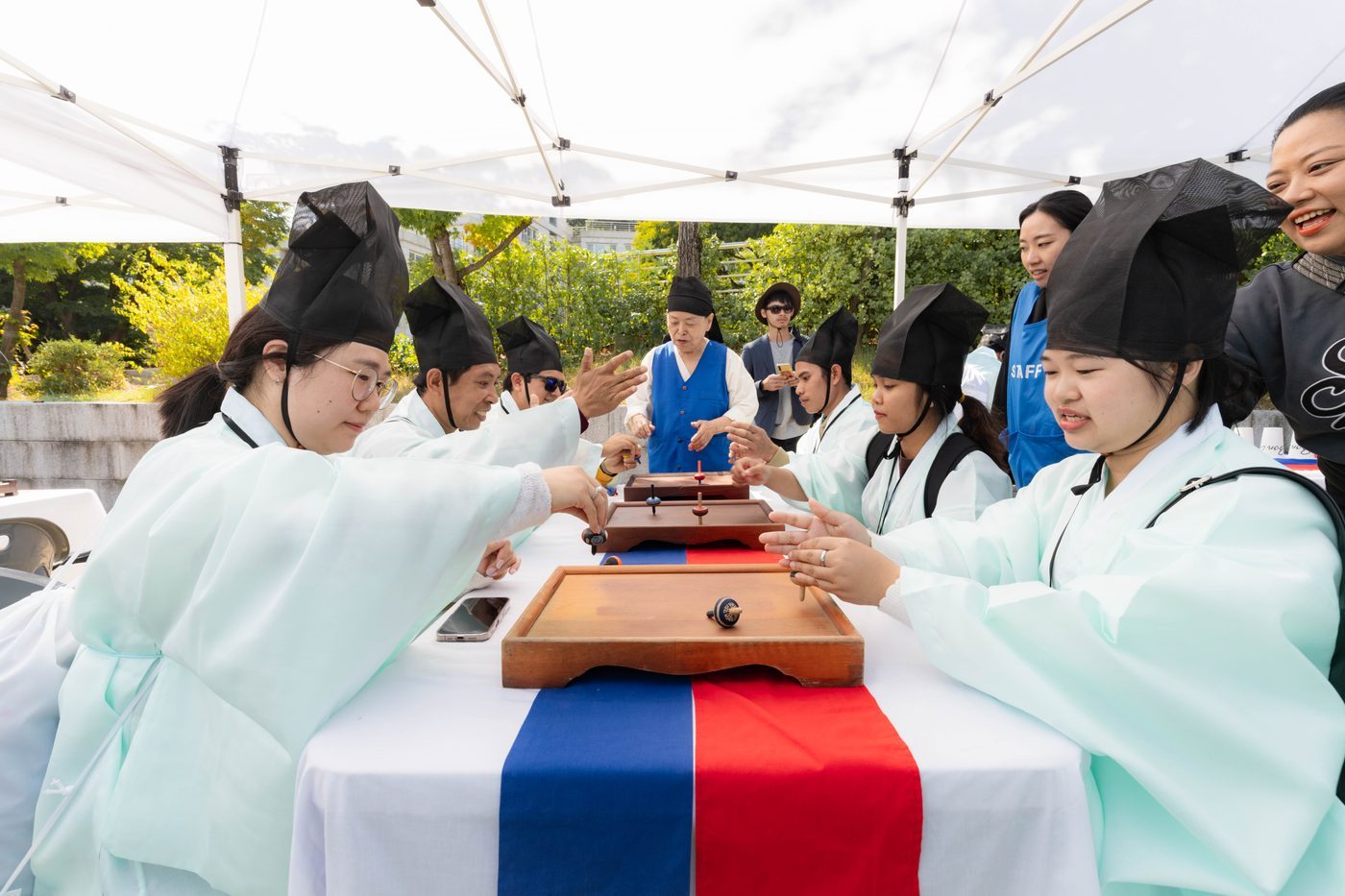
01BEYOND BORDERS
Communication Without Barriers
Intuitive rules understood through gesture and shared energy allow participants of every background to become teammates in an instant—turning unfamiliar glances into shared laughter.
02 · DAEDONG SESANG · GREAT HARMONY
A festive square of Daedong Sesang where people of all backgrounds connect in shared joy.
Not a contest to divide winners from losers, but the art of joining hands in a circle of shared joy.
Daedong Sesang (大同世上) — A world where people transcend borders, languages, and generations to live together as one.
At K-HUMAN, traditional Korean play goes far beyond nostalgic reenactment. It is a living cultural bridge where international residents and local citizens connect beyond words—placing harmony above competition and community above the individual in today’s public square.
Intuitive rules understood through gesture and shared energy allow participants of every background to become teammates in an instant—turning unfamiliar glances into shared laughter.
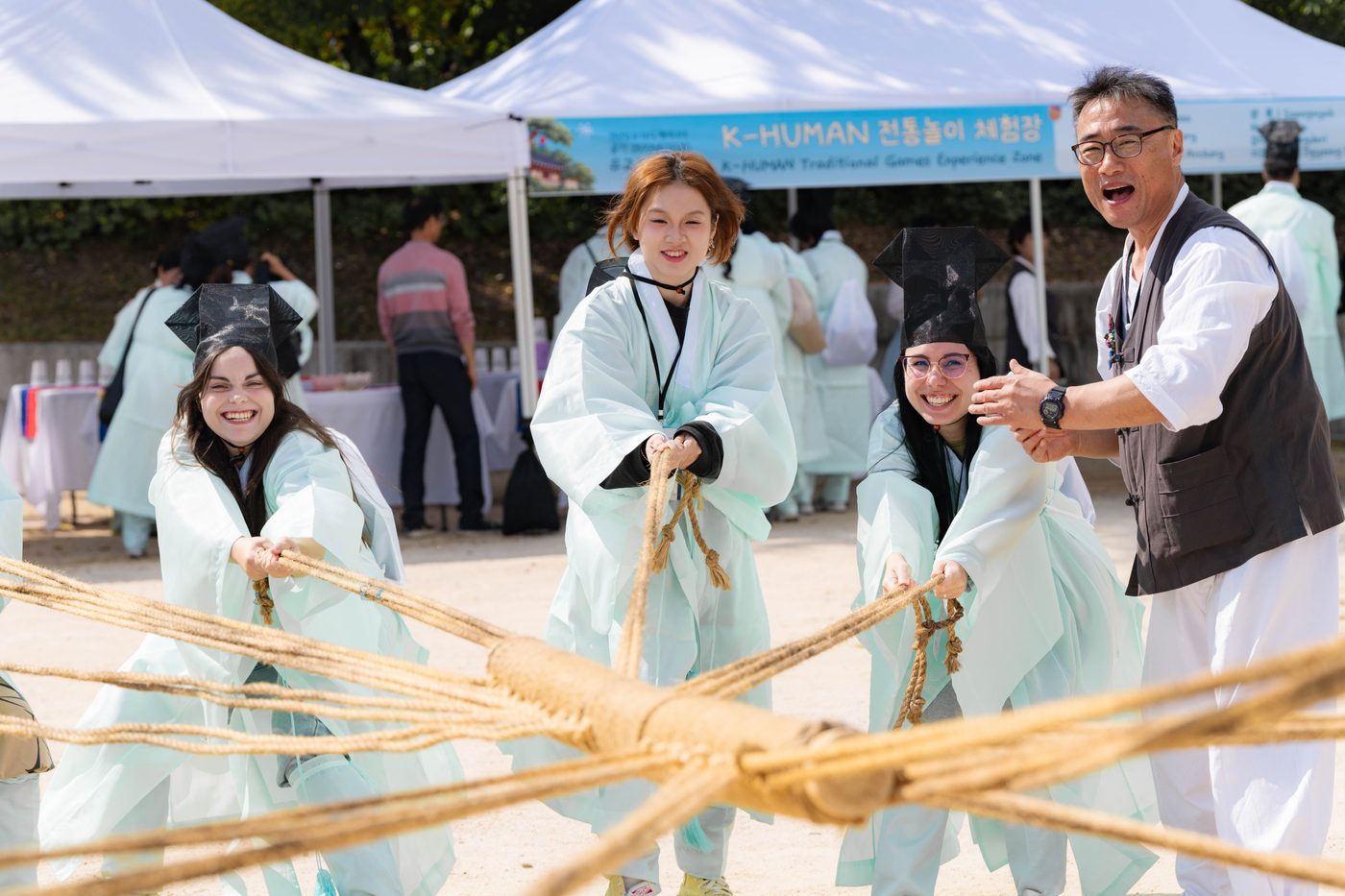
Cheering, laughing, and moving in sync matter far more than the final score—turning every match into a celebration of solidarity where every effort is applauded.
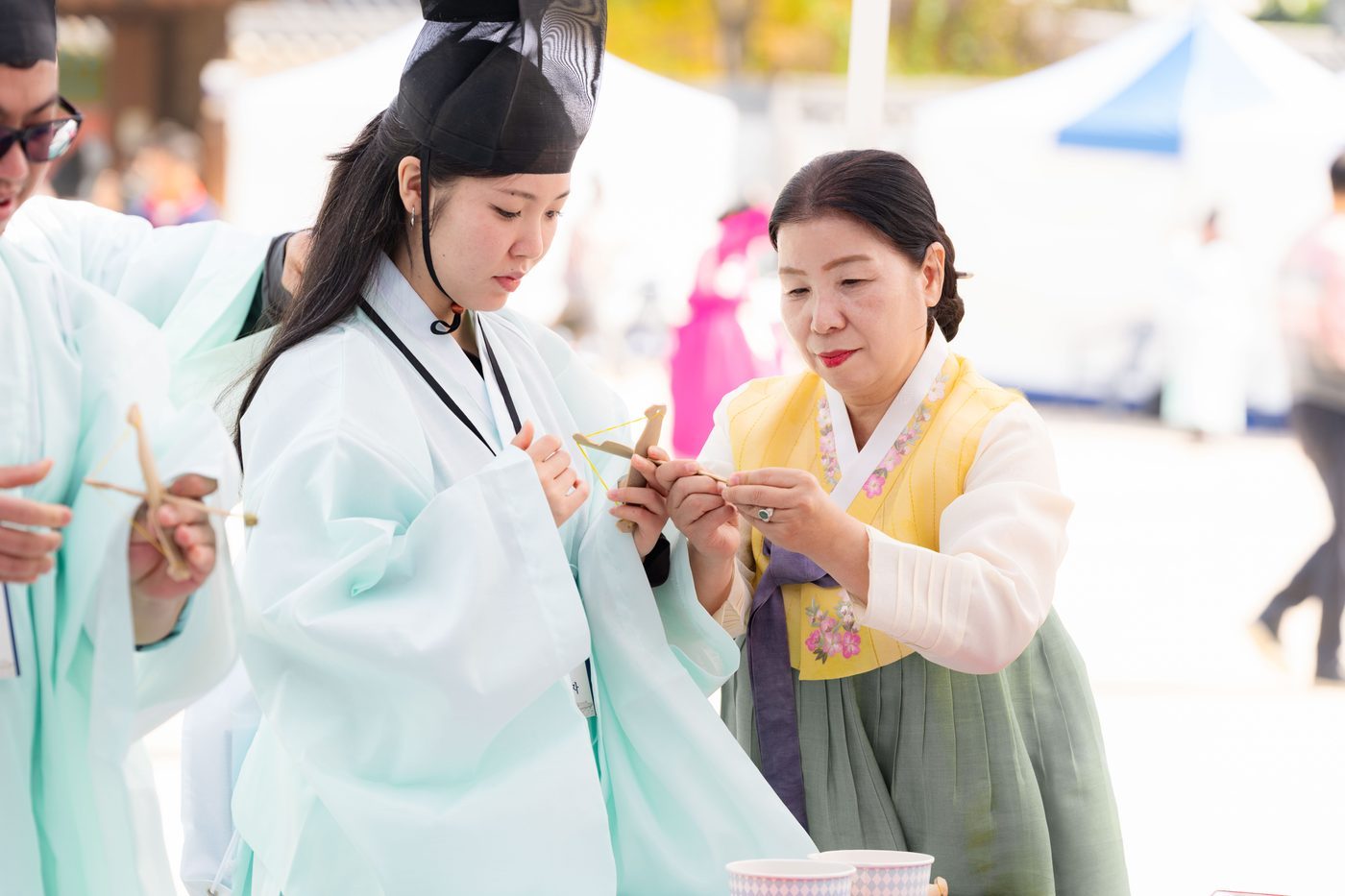
Rather than keeping tradition behind glass, we keep Korean folk culture alive through the voices and joy of global participants today.
21 folk games from our Experience and Exhibition Yards
Galdeung (葛藤, “conflict”) comes from kudzu vines and wisteria, which cannot be untangled once twisted together. Players toss rings made of these vines onto a goose’s neck to resolve conflict.
The traditional tug of war, named after a Korean phrase meaning “shorten the gang, pull the dari.” Ropes are tied to the central main rope (yongmok), one per person, and the two sides pull; the winning side is said to enjoy a good harvest.
A small bow made from a single bamboo joint shoots an arborvitae berry to knock down a target. Two large arborvitae trees stand before Daeseongjeon Hall at Sungkyunkwan because their berries repel pests.
Played since the Baekje period. In King Sejong’s reign a princess is said to have played all day, and Jeong Yak-yong was also a fine player. Rolling a six with the two dice gives a strong chance to win, hence “ssangyuk” (雙六, double six).
Villagers pack down the ground of a house site by pulling ropes tied to a heavy log, with a person riding in the middle. The spot for the foundation stones matters most in building a house, so the ground is tamped first.
Koreans have long been skilled with the great bow and were called “Dongyi” (東夷). Jumong and many other historical figures were fine archers, and archery is still the event that wins Korea the most Olympic gold medals.
The golf-like game King Sejong loved to play, called tagu (打毬). Players strike a wooden ball through five gates, and the lowest score wins. It was played some 50 years before golf in Scotland.
Called jigi (地碁) in Baekje. Versions include Chamgonu, Hobakgonu, Bakwigonu, Palpalgonu and Umulgonu.
On the last day of the twelfth lunar month in the Joseon era, the king invited children from outside the palace to play there wearing Bangsangssi masks.
A game introduced by Bang Jeong-hwan (pen name Sopa) in the children’s magazine “Eorini.”
Called wigi (圍碁) in Baekje. Many tales survive, such as King Gaero playing Baduk and King Seonjo playing with Li Rusong in the Joseon era.
A Joseon-era game of counting with twigs, also used to form various shapes.
Played by Sungkyunkwan students: pass the exam, win government posts, and learn the many ranks of office in advance.
Players match the characters that make up a sijo poem; played in village schools (seodang) and academies (seowon) of the Joseon era.
Played since the Bronze Age; the stations on the board are laid out like constellations.
The war game of China’s Han and Chu states came to Korea in the Goryeo period and developed into the Korean version of Janggi.
Played since the Baekje period. Kim Si-seup’s tale “Manboksa Jeopogi” has been handed down.
About ten people sit in a circle, each pretending not to be Cao Cao, while “Guan Yu” uses intuition to catch him.
Played since the Baekje period; players throw arrows into a jar-shaped vessel. An anecdote about Yi Hwang (Toegye) has been handed down.
Like Jojo Japgi, but Hong Gildong catches the corrupt officials.
A learning game played in Joseon-era local schools and academies to understand and memorize many sijo poems.
Reflections and field stories from K-HUMAN Traditional Play gatherings
