Skip to content
재한외국인 과거시험

03 · K-HUMAN CONTEST & DEBATE

K-HUMAN Contest & Debate

An intellectual forum pouring today’s questions into ancient traditions—where global minds reflect and converse.

Yoo Dong-geol

SPECIAL INTERVIEW

“We set out to show them Korea, yet they showed us a Korea we had not yet seen.”

Yoo Dong-geol

Judge, 1st Gwageo Exam for International Residents · Educator & Debate Specialist

A veteran Korean language and literature teacher who has taught in secondary schools since 1988 after graduating from Yonsei University. Former president of the Seoul Korean Language Teachers’ Association and planner of the national “Warriors of Debate” training program, he is the author of Warriors of Debate 1 & 2, The Powerful Do Not Debate, and Reading Yeom Sang-seop’s Three Generations Through Questions.

PART 01

Space & Encounter: Exchange Across Bicheondang and Myeongnyundang

Tradition learned through the body, and a forum of reflection opened by a question

Q01.

How did you feel when you were first invited to serve as a judge for the Gwageo Exam for International Residents?

A.

At first, I thought of it simply as an entertaining event. Even for Koreans today, the word “Gwageo” (the traditional civil service examination) feels distant, so seeing international residents take the exam in Joseon Confucian scholar robes sounded like a cultural event stitching past and present together.

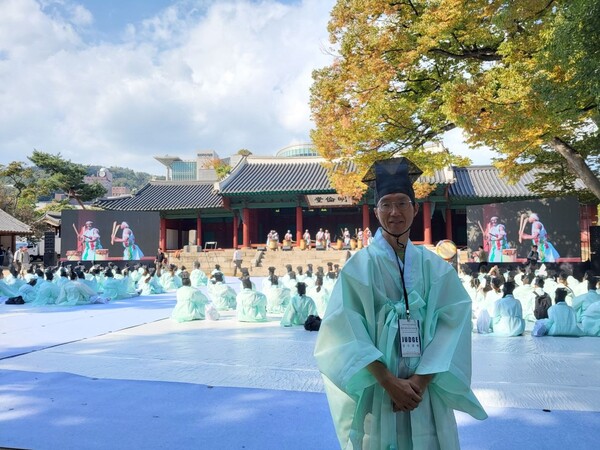
Yet the moment I stepped into Sungkyunkwan, my perspective shifted. Traditional games were unfolding at Bicheondang Hall, while preparations for the actual exam were underway at Myeongnyundang Hall. The two spaces were connecting past and present in entirely different ways. Bicheondang was a place to meet tradition with the body, and Myeongnyundang was a place to write about Korea with thought. At that moment, I realized this gathering was closer to “pouring today’s questions into an ancient vessel” than merely reenacting the past.

Q02.

How did you view the traditional games held at Bicheondang Hall?

A.

It was deeply memorable. Watching international participants in scholar robes shoot bows, toss rings, learn Ssangnyuk and Tagu, and pull together in tug-of-war was both joyful and moving. It reminded me that tradition is not learned from a manual—it is learned through the body. A bow becomes a bow only when drawn; tug-of-war becomes real only when people pull together. Even traditional rhythms enter the body only after stamping one’s feet and clapping hands.

At Bicheondang, bodies understood one another before words ever did. Though languages differed, laughter was shared; though rules were unfamiliar, the moment play began, everyone quickly became one team. Cultural exchange may sound grand, yet perhaps its true beginning is just this simple.

Q03.

What felt most meaningful to you as you observed the event as a whole?

A.

That it did not stop at merely “showing” tradition. Had it ended with sharing food, playing games, wearing scholar robes, and watching performances, it would still have been a fine cultural experience. Yet at the very end, a question was posed to the participants: “How have you seen Korea?” I believe this single question transformed the entire event.

It turned international participants from spectators observing Korean culture into interpreters giving meaning to Korea. Stepping out of a structure where we speak and they listen, a moment emerged where they spoke and we listened. Only then does genuine cultural exchange begin.

Q04.

Holding the exam at Myeongnyundang Hall must also have carried special significance.

A.

Indeed. Myeongnyundang (明倫堂) literally means “the hall that illuminates human ethics.” It was the central space at Sungkyunkwan where scholars studied and lectured. I felt its name resonated deeply with the day’s gathering. “Myeongnyun” does not simply mean illuminating knowledge. It means illuminating how human beings ought to live alongside one another—what relationships to build and what principles to uphold.

In that very hall, people from around the world were writing down their reflections on Korea. Centuries ago, scholars studied classics there to ask about human virtue; on this day, participants were asking how different cultures should meet. I recall hearing the Bailudong Rules recited aloud—though the questions had evolved, the essence of “how we understand one another across human boundaries” remained unchanged.

PART 02

Gaze & Discovery: Another Korea Written on Exam Sheets

Depth of thought and human warmth shining beyond grammatical perfection

Q05.

What did you prioritize most while judging the exam papers?

A.

Before grammar or spelling, I looked for whether the writer had “their own perspective” and “how deeply they understood Korea.” It does not matter if sentences lean slightly off-center. The human heart never moves like rigid printed type.

I looked for three things: Did they truly listen to the question? Did they answer from lived experience? And did they explain in their own words why it mattered? Rather than polished prose, sentences bearing the imprint of a person’s life held my gaze longest. Writing is not a display case of facts—it is the trace of how one person has looked at the world.

Q06.

What surprised you most while reading the participants’ answers?

A.

That the Korea we habitually take pride in and the Korea discovered by international residents were subtly different. We usually think first of Hangeul, Bulguksa Temple, Seokguram Grotto, Arirang, and kimchi. Many essays did explore those, and some participants showed remarkable depth—going beyond listing heritage sites to explain the history and spirit within them.

Yet others wrote about convenience stores. Some wrote about the subway and transit network, others about fast public administration, and still others about Korean “Jeong” (affectionate solidarity). It made me wonder: cultural heritage lives not only in ancient stone and timber, but also in how people live today. What we stand too close to notice was being seen clearly from a slight distance.

Q07.

Was there a particular essay that stayed with you?

A.

An essay written about “Jeong (情)” has stayed with me. Jeong is a remarkable word. “Love” feels slightly insufficient, “friendship” too broad, and translating it simply as compassion or intimacy still leaves something unspoken. Yet one participant unpacked the word through personal experience: sharing meals, looking out for one another, waiting in quiet patience, and the warmth that gradually forms between people over time. Reading it, I felt that Jeong is not a dictionary word in a universal language, but a temperature slowly generated between human hearts.

Other essays on Bulguksa or Hangeul went beyond praising their beauty to explain how they connect to the Korean spirit. It reminded me again that good writing is not writing packed with data, but writing marked by lingering attention to a single subject.

Q08.

Was it difficult to judge participants with widely varying levels of Korean proficiency?

A.

It was certainly not easy. Some wrote in fluent Korean, while others built sentences slowly, searching word by word. Yet this was not a Korean language proficiency test. Clumsiness in language and depth of thought are never the same thing. Someone eloquent may hold shallow thoughts, while someone who stumbles over words may carry a deep river within. That is why I sought density of thought over grammatical polish.

Even if rough around the edges, essays saying “I experienced this in Korea, and this is what it led me to think” moved me deeply. Before writing is a technique of accuracy, it is the act of seeing the world through one’s own eyes.

PART 03

Boundaries & Coexistence: The Richness Born of Difference

Korean identity reflected in another’s gaze, and the grammar of living together

Q09.

How did you view the wide age range of participants, from high school students to people in their seventies?

A.

A student from the high school where I teach participated, and an elderly couple attended as well. I had expected mostly university exchange students, so seeing people across generations stood out vividly.

People of vastly different ages wore the same scholar robes, received the same prompt, and wrote their answers side by side for the same duration. Watching them gave the word “Gwageo” a new resonance. On that day, nationalities, ages, and skin colors differed, yet before a single sheet of paper, everyone stood as equals. That scene alone made the gathering profoundly beautiful.

Q10.

Could we say that Korean identity became clearer through the eyes of international participants?

A.

I believe so. Identity becomes clearer when standing face-to-face with another than when looking into a mirror alone. The question “Who am I?” is ultimately tied to “How am I different from you?” Reading their answers led me to rethink what Korea truly is.

Korea was not only Hangeul and Bulguksa. Kimchi and Arirang are Korea, convenience stores glowing late at night are Korea, punctual subways and the heart that shares food with a stranger are Korea. Identity is less a rigid artifact preserved inside a museum than living strata continuously layered from the old and the new.

Q11.

In turn, can living in Korea shape a new layer of identity for international residents as well?

A.

I think it can. A person is never defined by nationality alone. Where one was born matters, yet whom one meets, what language one learns, and what meals one shares also shape a human being. When someone from abroad lives in Korea and comes one day to understand “Jeong,” a small Korea has already taken root within them.

Conversely, when we meet international friends and learn their culture and language, a small piece of another world takes root within us. Cultural exchange is not an encounter that erases who we are, but the act of planting different worlds inside one another.

Q12.

As Korean society rapidly becomes multicultural, what attitude should we take toward “difference”?

A.

I hope we do not try to erase difference. We often feel uneasy around difference. When speech, food, skin color, or faith differs, we instinctively wish to make it identical to ourselves. Yet culture grows rich not when everything becomes the same, but when differences coexist.

Think of an orchestra. If every instrument were a violin, the music would be monochrome. Music comes alive because cello and flute, drum and pipe sound differently together. At the finale of this event, Korean pungmul percussion, mask dance, and African drums resonated together—wasn’t that moment radiant? Society is no different. Difference is not an error to correct, but the foundational grammar we must learn to live together.

PART 04

Archive & Future: Dreaming of “Korea Written by the World”

A tradition that survives by flowing, and a chronicle of ongoing questions

Q13.

Some worry that preserving “our own heritage” conflicts with embracing other cultures. What are your thoughts?

A.

I believe the exact opposite is true. Those confident in their own culture have no reason to fear another’s. When Korean pungmul and African drums play together, pungmul does not vanish—each rhythm rings out even more distinctly beside the other.

Tradition placed inside a glass case may be preserved, yet it can hardly remain alive. It survives by meeting people, encountering other cultures, and evolving at times. A river does not disappear because it flows; it is a river precisely because it flows. Culture is the very same.

Q14.

How do you hope this program will grow in the years ahead?

A.

I hope this grows beyond an annual event into a living cultural heritage of its own. Joseon’s Gwageo exams ended long ago, yet we still speak of their records and institutions. If today’s Gwageo Exam for International Residents continues for ten or twenty years, it will become a chronicle of our era.

The exam essays themselves are vital. Some years may highlight Hangeul and Bulguksa; future eras may record democracy, technology, popular culture, or environmental stewardship as the face of Korea. Rather than mere test papers, they become a timeline of how the world has viewed Korea. I hope outstanding essays are gathered into books, translated into multiple languages, and preserved in exhibitions and digital archives.

Someday, I hope a book with this title is published: “Korea Written by the World.” If ten or twenty volumes of that book accumulate, they will become a cultural heritage more vivid than any stone in a museum.

Q15.

If you were to summarize your day as a judge in a single sentence?

A.

We set out to show them Korea, yet they showed us a Korea we had not yet seen. At Bicheondang, people played together—shooting arrows, tossing rings, and pulling ropes, setting aside borders of nationality and language. At Myeongnyundang, people wrote—transferring the Korea they had encountered onto a single sheet of paper inside a hall named for illuminating human ethics.

Some wrote of Hangeul, some of Bulguksa; some wrote of kimchi and Arirang, and others of convenience stores, subways, and human “Jeong.” All of it was Korea. The Korea of old and the Korea of today, the Korea we knew and the Korea we had yet to discover met upon a single exam sheet.

Though seated as a judge, I came to feel that I myself was taking an examination posed by a new era and history. How well do I truly know Korea? How ready are we to welcome those different from ourselves? And how far can the boundary of what we call “Korean” expand?

“The Gwageo exam has ended, yet the questions continue.”